
Security solutions
Vehicle security & ANPR
Control the vehicle, verify the driver, and keep a record of every entry and exit.
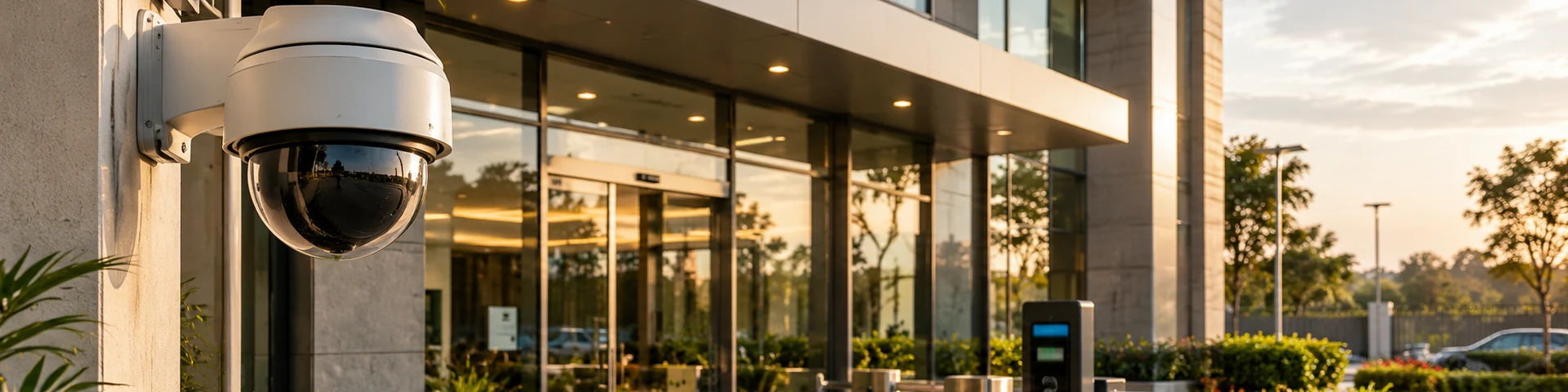
The hardest point on most sites to control
Vehicle access can be one of the most difficult points to control in a large facility. Traffic arrives in bursts, drivers are not always the people expected, delivery vehicles need somewhere to wait, and a barrier that is opened to clear a queue stops being a security control.
Logitech Consultants integrates vehicle identification and access technologies into a single process: the vehicle is identified, the driver or visitor is verified, the camera records the event, the barrier responds, and the access record is written. Each of those steps can be designed to work on its own, but the value comes from the chain holding together under real traffic conditions.
What vehicle access covers
-
01
Automatic number plate recognition
ANPR cameras read plates on approach so authorised vehicles can be recognised without a stop, and exceptions can be directed to a second line of verification.
-
02
Barrier and gate control
Rising arm barriers, hydraulic barriers and vehicle gates operated by the access decision rather than by a guard's remote, with manual override retained for emergencies.
-
03
RFID vehicle identification
Tag-based identification for fleets, staff vehicles and regular contractors, useful where plates are obscured, duplicated or change between vehicles.
-
04
Driver and visitor verification
Checking who is actually driving against the vehicle record, with visitor and contractor vehicles handled through pre-registration or a staffed verification point.
-
05
Parking access control
Barrier and entry control for staff, visitor and reserved parking, coordinated with the site's parking allocation so that access rights and parking rights agree.
-
06
CCTV integration
Each vehicle event linked to recorded images of the vehicle and driver, so the access log can be reviewed as evidence rather than as a list of plate reads.
-
07
Vehicle access logs
Entry and exit records with time, lane, plate, credential and verification outcome, retained and searchable for investigations and audits.
How the vehicle process is designed
Lane design and traffic flow
A vehicle control system succeeds or fails at the lane. We look at approach speed, queue length at peak times, turning circles, signage, lighting at the plate-reading point, and what happens to a vehicle that is refused entry. Lanes are then designed so that reading, verification and barrier operation happen in a sequence a driver can follow without instruction.
- Separate entry and exit lanes where volume justifies it
- Dedicated lane for deliveries, contractors and heavy vehicles
- Holding area for refused or unverified vehicles, clear of the public road
- Signage and road markings that match the process, not just the equipment
The verification chain
The chain we design follows the site's requirement: ANPR identifies the vehicle, the vehicle database confirms whether it is expected, the driver or visitor is verified by credential or at a staffed point, CCTV records the event, the barrier responds, and the access record is written. Where a vehicle is not recognised, the process routes it to a defined second step rather than defaulting to an open barrier.
Integration with the wider security environment
Vehicle access rarely stands alone. We connect ANPR and barriers with access control so pedestrian and vehicle records share one platform, with under-vehicle inspection and screening where the site requires it, and with command and control so the control room sees lane status, alarms and video together. For sites with several entrances, the same rules apply at each one, and records roll up to a single view.
Implementation and support
Vehicle systems are exposed to weather, traffic and daily wear, so commissioning and maintenance matter as much as the specification.
- Civil and electrical works coordinated with the site so that barriers, loops and cameras are installed without closing the entrance for long periods.
- Commissioning at peak traffic where possible, to confirm read rates and queue behaviour under the conditions the site actually experiences.
- Training for guards and control-room staff covering verification, overrides, exception handling and the audit trail.
- Preventive maintenance covering camera alignment and cleaning, loop and barrier checks, controller health and plate-read accuracy.
- As-built documentation with lane layouts, vehicle database ownership and a defined process for adding or removing authorised vehicles.
Questions we are asked
How accurate is number plate recognition?
Accuracy depends far more on the installation than the software: camera angle, distance, lighting, plate condition and vehicle speed all matter. We design the reading point for consistent conditions and test read rates on site. Where plates are unreliable, RFID or manual verification provides the fallback.
Do we need ANPR if we use RFID tags?
They answer different questions. RFID confirms that an authorised tag is present; ANPR tells you which vehicle is physically there. Many sites use RFID for staff and fleet vehicles and ANPR for visitors, deliveries and enforcement, with both feeding the same access record.
How are visitors and deliveries handled?
Either through pre-registration, where the plate is added to the expected list before arrival, or through a staffed verification point with an intercom and camera. Deliveries are usually given a separate lane or holding area so that a long unloading stop does not block the main entrance.
What happens if the network or power fails?
Barriers need a defined fail-safe position, and lanes need a manual release that guards can operate under supervision. Records buffered locally are synchronised when the link returns. We agree the failure behaviour for each lane with you and test it during commissioning.
Can it work across multiple entrances?
Yes. Rules and vehicle lists can be held centrally and applied at every lane, while each entrance keeps operating if it loses its connection. A control room can then see entry and exit activity across the whole site rather than entrance by entrance.
Related capabilities
Let’s build the right solution
Tell us what you are trying to achieve. We will help you assess the requirement, shape the architecture and identify the technology needed to deliver it.