
Operating environments
Industries
Different sectors carry different risks, rules and rhythms. The technology has to fit the environment it runs in.
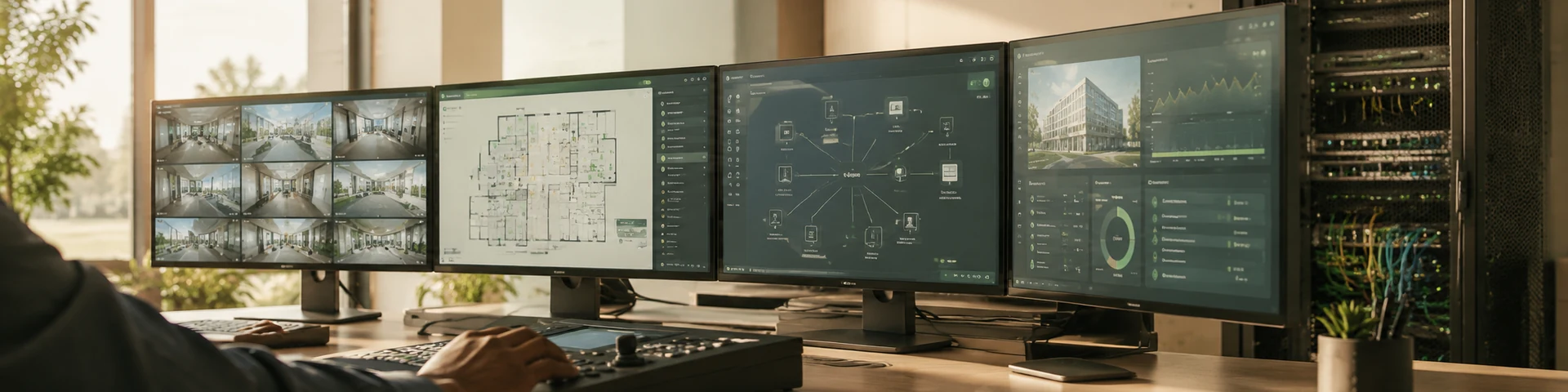
Solutions for real operating environments
A hospital, a county office, a manufacturing plant and a hotel all need access control, surveillance and connectivity, but they do not need the same system. Patient privacy, public access, shift patterns, hazardous areas, regulated records and opening hours all change what a sensible design looks like.
Logitech Consultants works across government, financial services, energy, telecommunications, healthcare, hospitality, real estate, aviation and other private-sector environments. That breadth is useful in practice: we have seen how the same technology behaves in very different settings, and we plan around the operating reality rather than a generic template.
Sectors we work in
- Government & public sector
- Airports & aviation
- Energy & utilities
- Banking & financial services
- Healthcare
- Manufacturing & industrial
- Transport & logistics
- Hospitality
- Education
- Corporate & commercial
-
01
Government & public sector
Digital services, revenue processes, secure facilities and connected operational systems, where public access and protected areas have to coexist.
-
02
Airports & aviation
Access, screening, surveillance and communications for demanding environments where throughput, regulation and security meet.
-
03
Energy & utilities
Site security, connectivity and monitoring for distributed operations, remote assets and facilities that cannot afford an outage.
-
04
Banking & financial services
Controlled access, network infrastructure and surveillance across branches and head-office environments where uptime matters.
-
05
Healthcare
Health information systems, clinical networks and restricted-area security that support patient care rather than interrupting it.
-
06
Manufacturing & industrial
Perimeter and gate control, plant-floor connectivity and integration for production sites where uptime and site safety matter.
-
07
Transport & logistics
Yard and warehouse visibility, gate control and connected operations across depots, fleets and distribution centres.
-
08
Hospitality
Guest and visitor access, communications, audio visual systems and business applications for premises that serve the public daily.
-
09
Education
Campus access, surveillance, connectivity and learning-support systems for institutions with open campuses and fixed term dates.
-
10
Corporate & commercial
Access control, surveillance, meeting-room technology and business applications for offices and mixed-use commercial premises.
How sector context changes the design
Rules, records and duty of care
Sector obligations shape what a system must retain, who may see it and how long it stays available. Healthcare records, financial transaction trails, public-sector revenue data and aviation screening records each carry their own expectations. We design retention, permissions and audit trails around those obligations rather than bolting them on afterwards.
One estate, many sites
Branches, campuses, plants and distributed utility assets raise the same questions: what is managed centrally, what must keep working when a link fails, and who responds when something happens at 03:00. We plan multi-site deployments so local operations continue independently and central oversight adds to that rather than replacing it.
Working inside live operations
Most of our clients cannot close while a system is replaced. Installations are sequenced around trading hours, term dates, clinical schedules and production shifts, with staging, temporary coverage and cutover plans agreed in advance. Where legacy systems must stay in service, we phase the migration instead of forcing a single high-risk switchover.
Implementation and support
Familiarity with a sector shortens the assessment; it does not replace it.
- Requirement workshops with the people who operate the environment, not only with its management.
- Design work that reflects the sector's compliance obligations, access rules and operating hours.
- Implementation sequenced around live operations, with staging, temporary coverage and agreed cutover windows.
- Training for the staff who will use the system daily, plus documentation for the teams that maintain it.
- Support and maintenance arrangements that account for the sector's tolerance for downtime.
Questions we are asked
Which industries do you work with?
Government and public sector, aviation, energy and utilities, banking and financial services, healthcare, manufacturing, transport and logistics, hospitality, education, and commercial organisations. The common thread is an operating environment where security, infrastructure and business systems have to work together.
We are a public institution. Can you work within our procurement process?
Yes. We can provide the technical documentation, drawings, specifications and compliance information that formal procurement usually requires, and we work to the process our client has to follow rather than asking them to work around ours.
Can you handle multiple sites?
Yes. Multi-site deployments are planned with a clear split between what is managed centrally and what must keep operating locally, so a branch, campus or plant is not dependent on a single link to Nairobi.
Can you integrate with systems we already run?
In most cases, yes. We assess the existing equipment, cabling, network and applications first, establish what can be reused and what has reached end of life, and propose a phased route where that reduces risk or cost.
Do you provide support after handover?
Yes. Support can range from corrective maintenance and agreed response times to preventive servicing, health checks, training refreshers and lifecycle planning. The scope is agreed before implementation so responsibilities are clear at handover.
Related capabilities
Let’s build the right solution
Tell us what you are trying to achieve. We will help you assess the requirement, shape the architecture and identify the technology needed to deliver it.