Systems Integration
Why security, ICT and digital systems work better as one architecture
Cameras, access control, networks and business applications deliver more when they share one design. Here is what integrated architecture changes in day-to-day operations.
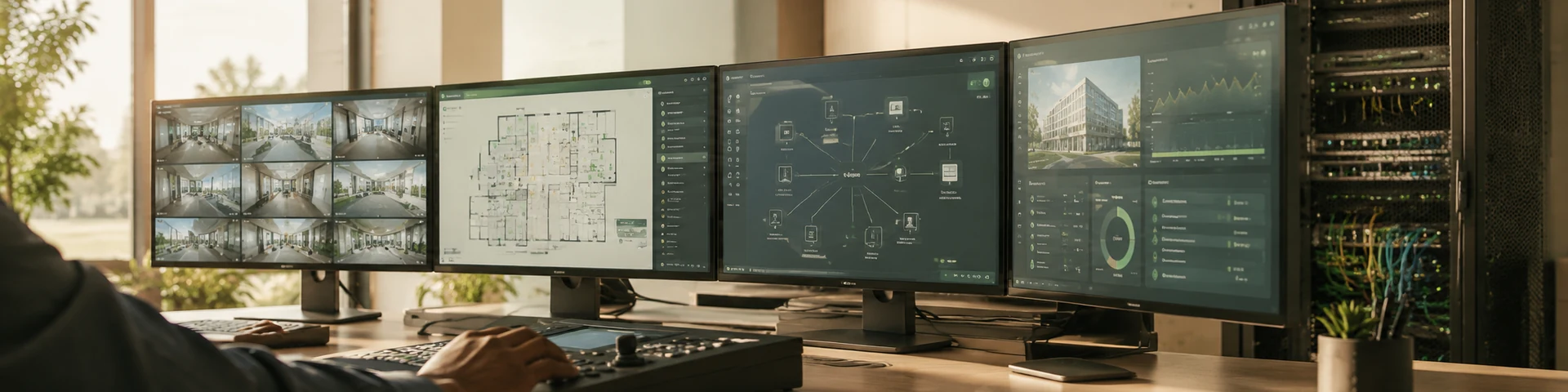
Most organizations do not run a single technology platform. A site has cameras from one manufacturer, access control from another, a network built by a third supplier and business applications that were bought for a different purpose altogether. Each system works. The problem starts when they have to work together.
Systems integration is the work of making those systems behave like one operating environment. At Logitech Consultants it sits at the centre of how we design security, ICT and digital projects, because the value of technology rarely comes from a single device. It comes from what the organisation can see, decide and act on once the systems are connected.
Three capabilities, one operational picture
It helps to follow a single event through an integrated environment. A camera detects movement at a perimeter gate. Access control establishes who is authorised to be there. The network carries that information securely to a monitoring point. A digital platform records the event next to the visitor record and the vehicle log. Command and control presents it to the officer on duty, and management sees the pattern in reporting the following week.
Any one of those steps can exist on its own. Put together, they turn a camera feed into an accountable record of what happened, who was involved and what was done about it.
Where disconnected systems break down
When systems are bought separately, the gaps usually appear in the same places:
The same person or vehicle is registered in three different systems, and the records never match.
Guards and operators reconcile events by radio and paper because nothing joins the systems up.
Response times stretch while someone walks to a different room to check a second screen.
Reporting is assembled manually at month end, so decisions are made on information that is already old.
Every new site adds another stand-alone platform to support and train.
None of these are failures of the individual products. They are failures of architecture.
What an integrated design looks like
Integration is not a product you buy at the end of a project. It is a set of decisions taken at the start, and it usually includes:
A single requirement document covering security, network, applications and the people who will operate them.
Agreed data standards so identities, sites, vehicles and events mean the same thing across systems.
A network designed for the load the security and business systems will place on it, including redundancy where the operation cannot stop.
Interfaces between platforms, whether through documented APIs, middleware or agreed data exchange.
One monitoring and reporting layer instead of a screen per vendor.
A support model that covers the whole environment rather than individual boxes.
Individually, these technologies solve specific problems. Together, they create an integrated operational environment — and that is where the return on the investment sits.
Start with the requirement, not the product
Integration fails when it is treated as a technical afterthought. Our method is deliberately simple: understand the environment, define the requirement, design the solution, integrate the technology, then support the outcome. The order matters. Once the operational requirement is clear, the technology choices become easier to justify and much easier to test.
That approach also protects the investment. A design that starts from requirements tends to scale: additional sites, additional users and new systems can be added to the same architecture instead of replacing it.
Questions worth asking before your next project
Which systems will need to exchange information, and in which direction?
Who will operate the environment day to day, and what will they actually look at?
What has to keep working if the network, power or internet link fails?
Which records must be retained, for how long, and for whose audit?
How will the solution be supported after commissioning, and by whom?
If those questions are answered before equipment is specified, the project has a far better chance of being operational on day one rather than a collection of systems that happen to share a building.
Logitech Consultants designs, integrates and supports security, ICT and digital solutions for organizations across Kenya. If you are planning a project that spans more than one technology area, we can help you assess the requirement and agree the architecture before anything is procured.